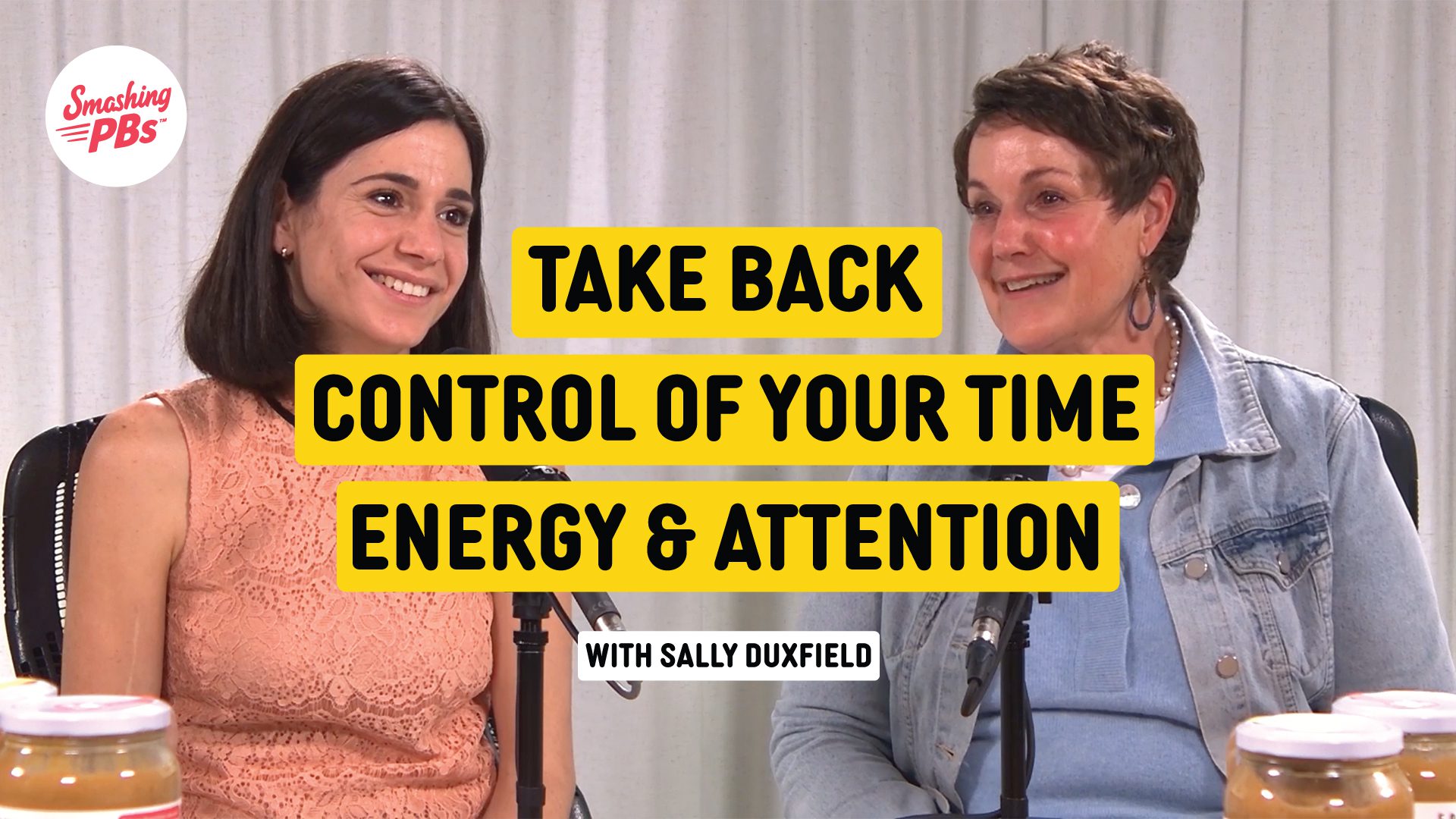
Good morning, Sally. Thank you so much for coming on the Smashing PBS podcast. I’m really happy to have you on as a guest. I’m excited about this episode. You’ve got lots of wisdom that I’ve already heard some of it in the past. But yeah, how’s your day been? How are you going?
It’s been great. Thanks so much for having me. It’s delightful to be here. I started this morning at 7:00 with one of my coaching clients. He’s a CEO of a large organization and we spent a couple of hours over breakfast together. But what was really interesting was we started with his family life and we talked about how dad could be present when he walked in the door because he’s only in his 40s. He’s got great expectations in the professional environment, but to sustain performance and be support, he’s actually got to be a really good dad first. So, we were just talking through what he could do around sleep, sleep performance, and also being present for his kids. So, yeah, we started there and we’ll work our way through to the boardroom in due course.
I love it. I think that’s something people often talk about work life balance and I feel like, especially if you’re in your own business or if as you say are a CEO or dedicated to what you’re doing, there isn’t always a balance as such; it’s just figuring out which bit gets the most attention at that particular moment.
Yeah. And I’ve always said there’s no such thing as work life balance. It’s a fallacy. So basically it’s a phase of your life and at certain phases you’re a 100 hour a week woman and at some of your phases you can change that application of your energy, but it’s just about where you’re putting your energy. No such thing as work life balance.
I love it. I can finally feel good about the fact that I have no balance. So that’s great.
No balance is good.
Okay. I want to start from I guess the why. You’ve spent years helping high performers build structure, balance, and impact. When and why did you realize you’re so passionate about this?
Good question. So what I found in my military times was that when things got tough, when people were uncomfortable, people didn’t handle discomfort very well. And I think it’s a reflection, I mean I’m in my 60s now, so I’m quite old. I think now we’re even in a worse situation with young people. As soon as there’s friction and we become uncomfortable, we pick up our phones and we find some dopamine. Whereas in the olden days, I was used to boredom. I was used to entertaining myself, walking outside, finding a tree to climb. Nowadays, you can’t. You travel on a bus or public transport and nobody is looking out the window.
You’re so right.
Everybody is ingrained in their phone and they are getting noradrenaline, norepinephrine, which is a focus neurotransmitter, but it also drives agitation and movement. Many people will say to me, “I can’t focus. I must have ADHD.” In fact, you’re probably just a drug addict. You’ve probably got too much dopamine. You’re just driven by dopamine, which is a motivation and a forward movement neurotransmitter. It drives motivation. And then you couple that with norepinephrine because your eyes are really focused on your screen. When your visual aperture is narrow, it increases your noradrenaline which means your focus increases, you’re constantly hypervigilant and constantly looking for more entertainment, more pleasure. And so I found from my military days that I needed to understand neurobiology, not psychology, because smart people become really dumb under pressure. Smart people can come up with something that’s not logical because the brain is not logical under stress. Once you get a stress load, your prefrontal cortex is shutting down by about 60 to 80%. Two minutes into stress and somebody is 60% more stupid than they were two minutes ago. So yeah, that’s how I got into it.
I mean that’s really, you have just dumped a lot of incredible stuff. But I’m going to go with the phone addiction. I can put my hand up and say I would say I’m addicted to my phone. I think part of the problem is that there are so many different functions that your phone has, but when you pick it up, your brain forgets the particular task that you were supposed to do. You might want to take a photo, but then it shows you your previous photos. Or you might want to check a message, but then it’ll have five other messages. So you click into one and next thing you know you’re on some social media platform looking at 100 videos and you can’t even remember why you picked up your phone.
It’s really simple. So one of the things is you need to clean up your phone. Dopamine is more addictive than alcohol and nicotine. We start with a baseline dopamine, and then if we pick up our phone and look at some reels, we increase our baseline dopamine by about 350%. Within 11 to 15 minutes, not only has it dropped back to baseline, but it’s dropped below baseline. So we want more reels. But the next time we continue reeling, those dopamine receptors take about an hour to refill. Dopamine is like the big party girl and she fires up your adrenal system. So now you’ve got the energy and the motivation to keep reeling. But start thinking about when you’re on your phone, pay attention to how quickly you start moving through your reels. You start off quite slowly and then next minute you’re like 2 seconds, 2 seconds, 2 seconds. The second dose of dopamine is about 25% of that first dose. It’s a bit like a glass of wine; for the first glass, say it’s a 250% increase. Within 11 to 15 minutes, your brain is saying perhaps you could get another one. But the second glass doesn’t taste as good because the dopamine released is only 25% of the first. If we clean up our phones, shut off all your notifications, because that little red dot subconsciously says to your brain you’ve got a shitload of work you’ve just missed out on. It’s overwhelming, and then noradrenaline comes in and goes from focus to excitement to hypervigilance to anxiousness.
Yes.
Now all of a sudden I’ve got these feelings of anxiousness and overwhelm. We did some filming some years ago in the Middle East around giving people access to their phone. 55 people for 1 hour were told they were not allowed to touch their phone. How many times on average do you think they touched the screen?
I’m going to say 10.
57 times. Even though they weren’t allowed, they can’t help it. You have built a neuropathway, the neuroplasticity is so phenomenal. You’ve now got a major neuropathway between your dominant hand and your phone screen. People are getting false vibrations because their brain is imagining it. Their eye movement was what was phenomenal, over 363 times on average per hour, their eyes went from their minimized email icon to their screen to their phone, and every time your eyes move, that’s noradrenaline being released, which is driving agitation.
Yes.
So now you’ve got a behavior, the distracted brain, that looks identical on paper to ADHD.
Wow.
So if we clean up our phones and just move all of our apps to the app page, open up your phone and it’s got a clean screen on the front with no notifications. If I want to use Messenger or WhatsApp, it’s just the next swipe over. But no notifications. You can actually control how you use your phone because it’s a tool; it doesn’t own you.
Yes.
Couldn’t you argue though that the brain is clever enough that it will just get into the habit of picking it up and swiping straight away?
You could. I guess it’s taking a little time to reflect on how you feel. That’s why I love the residential retreats, the lived experience of actually not having your phone. We’re really prescriptive about our connectivity: first thing in the morning, do what you need for an hour. Then we have breakfast and not after breakfast. Then at lunchtime, fill your boots. But you need to put it down about 40 minutes before the next session because it takes a good 30 minutes to decrease the stress from that email you just read. And then at the end of the day, we do another session, but nothing after dinner because it is that dopamine and stress at the end of the day that’s affecting our sleep. My gig is sleep mastery. You absolutely can control this device, but unless you reflect physically on how you feel, shoulders less tight, more relaxed, you don’t understand how different you can feel.
I feel like there’s an expectation that we respond to things in a particular period of time and things are constantly urgent. It’s almost like we need to set up an out of office message to say, “Hey, I actually,” maybe I’ve solved it.
Yeah, you just solved it. Two days before, give a precursor warning to your clients by putting an out of office on, even though you’re in the office, saying you commit to checking your emails at 9:00 a.m. and 3:00 p.m. Train your clients as they come on board.
Interesting. And you almost have to actively plan your days for having those blocks.
Yeah. My second book was Impact 4Q, which is steeped in the neuroscience of Eisenhower’s matrix. Eisenhower had a vertical of urgent and a horizontal of important. I felt we didn’t need any more “urgent”, everything’s urgent. If a plane hasn’t crashed, it’s not urgent. The Impact model is “Value and Control.” Q1 and Q3 are “Hamsters and Monkeys.” You’re on the hamster wheel of life; it’s entrepreneurial life, it’s normal. Q3 is where people are hitting you from the side and bringing you their “monkey”, their problem, and they hand it to you. You end up with 27 monkeys on your shoulders and they’re not your monkeys. We need to say, “That’s a great question. How would you feed your monkey?” We need to coach.
I thought that was a really fantastic analogy.
When you set up the rhythm of your day, you naturally have high levels of adrenaline and motivation in the morning. So, get big stuff done in the morning, critical or difficult conversations. Afternoons, we run out of energy and our motivation’s dropping. Afternoons are softer, that’s your administration, emails, and creativity. If you wait all day for those difficult conversations, you’re not set up from a neurobiology point of view to have them. So, plan and think forward so you can come backwards.
I love it. I know you’re passionate about sleep. First of all, what time do you wake up and what time do you go to bed?
I’m not an early riser. I am a quarter to ten to bed person every single night. I only learned about reels a year ago and I realized that I wasn’t coming up for air for about an hour and twenty minutes. That’s why people are having these bad evenings, they start on reels and look at their watches and it’s 11:30 and now they have guilt and shame. The key to sleep is anchoring your bedtime and your wake up time to within 30 minutes every night. Every time you sleep in for more than an hour, your body starts to reset your whole circadian clock. It takes all of Monday and Tuesday to reset again. I recommend anchoring even on the weekends, get some sunlight on your retinas because sunlight tells the melatonin to stop and starts the adenosine signal. Adenosine is the debris from burning fuel that pushes sleep.
I’ll lie with my daughter and fall asleep, but then I feel like I can’t waste my evening, so I’ll get back up again and do all the wrong things.
Melatonin is a sleep signal which is triggered by light. One of the key sleep hacks is low light, get all your overhead lights off. The neurons in the upper eye receive the angle of the light. When we turn off overhead lights and put on a side lamp, we’ve changed the angle. We’ve said to the subconscious brain the sun has set, and that is the signal to start making melatonin. Dimming the overhead lights isn’t the same because it’s the same angle. Use nightlights everywhere, in the hall, the kitchen, the whole house. When I travel, I take nightlights with me. Get the overhead lights off as early in the night as you can. It anchors the brain to know what’s coming next.
What about movement? How does this tie in to living your best self?
The human body was made to move. There’s a difference between movement and exercise. Movement is what we should be doing all the time, just moving our body 10,000 steps. Exercise is where we’re training our cardiovascular system. Movement decreases the stress response. Have walking meetings and be the 2%, don’t use the lift, do the six stories of stairs. Wherever there’s an opportunity to move, such as using stairs instead of an escalator. For exercise, morning is a great time to do big exercise because of high adrenaline and dopamine. If you train at 9:00 at night, your adrenal load is going to be way off the scale and not conducive to sleep because melatonin and adrenaline can’t coexist in the blood.
How do you ensure you don’t become obsessed with your own data?
I’ve just told one of my clients to take his Aura ring off because he’s become obsessed and it’s not serving him. Don’t hop up and look at your data first thing. If it’s causing you concern, go back to an old analog watch. Get rid of the tech off your wrist because that is driving dopamine and compulsive behavior. Know yourself, if it’s helping you, keep going; as soon as you find yourself obsessing, take a step back.
Tell me about what your retreats are.
Arete is an eco retreat in the Tararua Forest Range. We’re bespoke and off grid. When you have friction in your environment, you’re vulnerable, which means you’re actually in the experience. We focus on sleep mastery and standing in the future to plan backwards using the RAS, the Reticular Activating System. It’s the filter that sorts through what you’ve said is cognitively important to you. If you visualize it in the morning, the brain will find synergies for you. I want you to articulate what your future dream looks like, and I’ll challenge you if you’re slightly delusional to set you up for success. We take you right through that process so you know what you need to walk towards.
How would you measure your own success or personal best?
My PB is to always continuously learn, I’m starting a PhD journey at 60. My personal best is also reflected in the joy I see in people. I teach a protocol called “Kids Zone”: get your kids to design a sign, and when you come home, the phones go into a little shoe box “bed” and you commit to no work for 2 hours. You are present. That simple thing for me is my personal best.
Thank you so much, Sally. Such a dream.