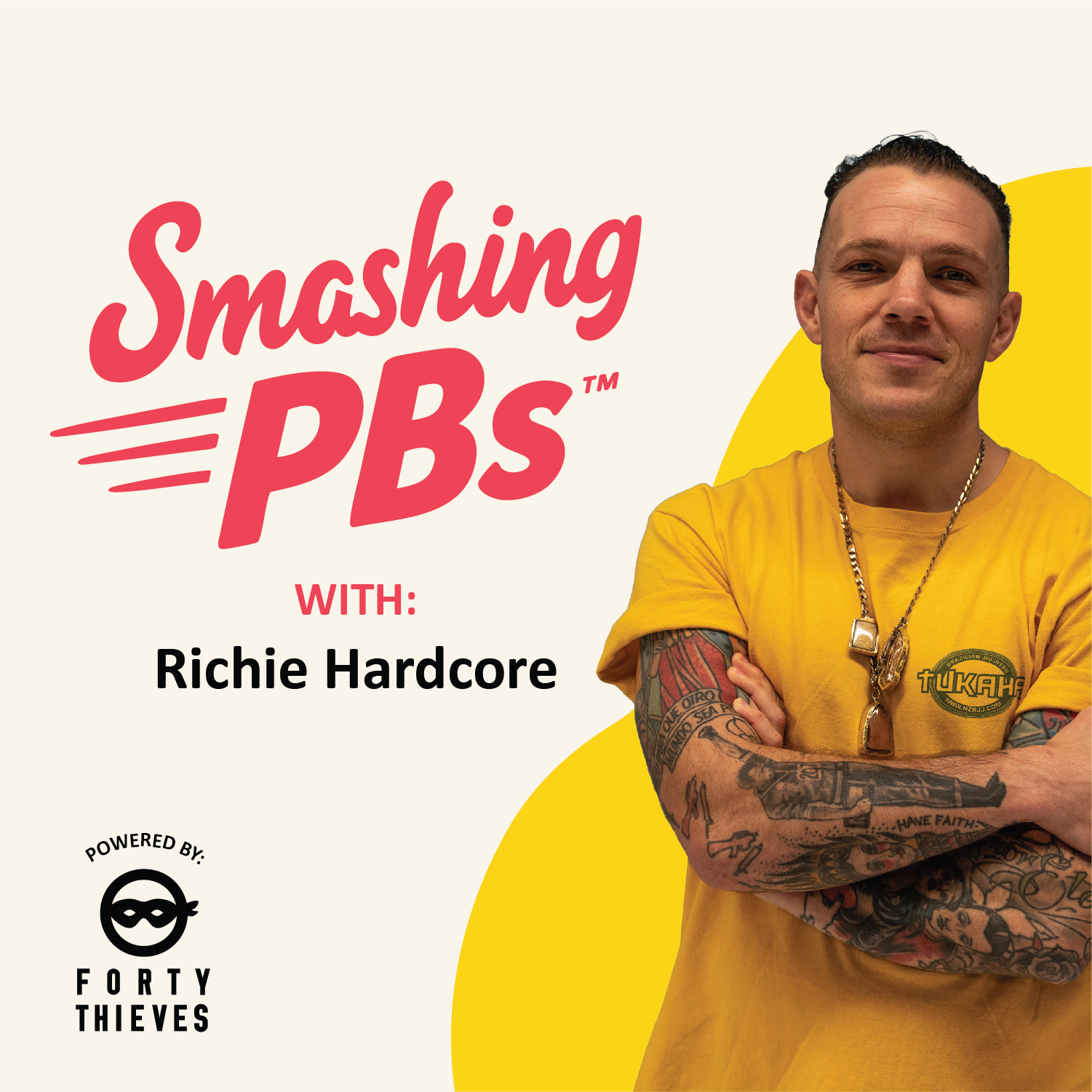
In this episode, I’m talking to Richie Hardcore, a former Muay Thai champion, Richie is known for tackling big topics like masculinity, consent and violence prevention. With a master’s in sociology and as a White Ribbon ambassador, he has an incredible ability to connect with people from all walks of life.
Hey Richie, thank you so much for coming along to The Smashing Podcast.
You’re welcome. Thanks for having me, I appreciate it.
Awesome. What did your you wanted your day look like before you got here?
Uh, my day looked like I was at my gym teaching Muay Thai. Cool. I trained a few kids in, like, alternative education and then have some private clients.
Wow. So it’s very busy.
Yeah, it’s pretty busy. It’s Life’s pretty busy. I also did an interview with Radio New Zealand early this morning. Wow. Far right. Yeah. So it’s been a it’s been a fun day.
Okay. Fantastic. Well, thank you for making the time. I think you’ve got so much to give. Um, on the topic of smashing TVs, um, for us, what that means is, uh, on this podcast, I guess the idea around trying to strive to be your personal best, what that looks like on a day to day basis. Or is it the bigger goals?
Everyone’s different. Everyone brings different things to the show. But I’m really excited for your your take.
Oh thank you I appreciate it I’m very humbled.
Yeah. Um, also, well, I mean, Muay Thai, we’ve talked we’ve mentioned that word a couple of times. That’s actually where I want to start with you. So you’ve been you’ve been training and, um, in martial arts from a young age. Um, and then you became a more Thai champion. Um, what? Yeah. What drew you to that sport?
Yeah. So I started martial arts when I was 13 years old. I did a career martial art called taekwondo. Freestyle. Taekwondo. Cool. Uh, at, like, the local community hall. Uh, my dad took me up there and said to the instructor, you know, because I asked my father how we started. Yeah. You know, my son started struggling with his self-esteem, blah, blah, blah, blah, blah.
Can you help my boy out and, um. Go, dad? Yeah, yeah, yeah. You know, it’s public knowledge. My dad struggled with, you know, alcoholism and mental health himself. So I had a pretty dysfunctional childhood, and I just really fell in love with martial arts from day dot. You know, it was the first thing that I really felt passionate about.
Interesting. I really liked the discipline and the structure and the hard work that I got out of, um, out of training and then competing like I had my first, like Semi-Contact.
Was this still.
Taekwondo? Yeah. Tournament. When I was like 13 years old, I was like, oh, cool. I get five people and I get in trouble. Wow.
That is actually world. It is a world concept that it’s like it’s such a respected sport and yet you are still fighting.
Yeah, well, I think there is. You know, some of us do have, um, that energy, you know. And where do you put that? You know, and you can put that in places that are constructive or destructive. Interesting. And I think martial arts gives us a space to hone all of that energy and that aggression and the interest and the anger and unresolved issues, and to something that builds us better rather than something that breaks us.
Right? Yeah. You know, so many people, but men in particular do struggle with a whole range of issues. And how does that manifest street violence, family violence, drugs and alcohol, car accidents. Right. So how do we give people something to put their energy into? Yeah. So for me, it was it was fighting.
And then it gave me a and then I started doing Mai Tai when I was 17. There was an older guy at high school and he was like, what you’re doing this week if you come to my gym? And I was like, I thought it was pretty cool. And then I went to his Muay Thai gym, Balmoral Lee, GA, which was a really famous gym. Yeah. Um, and I was like, oh, whoa.
It’s a whole different. It was a whole different level of of of physicality and technique and. Yeah, I just loved it again. You know, I fell in love with it all over.
And did you then you left. I guess you finished up with taekwondo, then you moved on.
Yeah. Yeah, yeah. I think I’d do like. I mean, there’s going back, but I do like taekwondo a couple of days a week and then Muay Thai a couple of days a week, and then just move straight into Muay Thai and have my first Thai boxing fight when I was 18. Yes. I still in high school. And then, yeah, we just go on to chip away at it for the next 20 years or so.
Wow. That’s amazing. Um, yeah, it’s quite incredible how a lot of, a lot of people’s stories start with I, you know, I went to this place or someone said this thing or something happened, and then it just changed the the direction of your life. So it’s quite incredible how. Yeah. Walking into this gym, um, this taekwondo gym just it just resonated with you.
And that became the direction that you continue to take and even to this day, um. How incredible.
Yeah, it was cool. I feel I love working with young people because I got so many benefits out of a lifetime in the sport. Yeah, like not just, you know, physical ones, but it taught me, like, discipline and structure and hard work and goal setting. And I want.
To hear about all of those. Yeah.
And eventually, like, I took all of that to like, academia and went to university. I marked around in high school. Yeah, but I got tired of working in jobs that weren’t fulfilling in my early 20s and went back to study, and I basically took the approach that made me successful at combat sports to study. Wow.
And, um, yeah, you know, that opened new doors, you know, and new challenges, but it’s a similar approach.
That’s so interesting. Yeah. You almost. Yeah. Like, I love the idea that you can train at something and one part of your life and then take those learnings and put them, apply them to a totally different part of your life. But so much of it transfers across, um, how? Tell me about Muay Thai. So I’m going to put my hand up and say, I don’t know that much about it, to be honest.
So give me, give me, give me a bit of a yeah. For someone who doesn’t really know much about the sport.
Yeah. Cool. So Muay Thai is the traditional fighting art of Thailand. Okay. And it’s, you know, hundreds of years old. It started out like most martial arts, is like an actual battlefield art, and then it’s evolved into a sport. Right. Okay. So historically, people would fight with, like, bound rope hands and stuff, and that’s evolved into like, gloves.
Like proper gloves. And it’s evolved to have rules, regulations, safety checks. And it’s become like a global professional sport. Um, and Thailand is driven by poverty. You know, children as young as five are fighting for Muay Thai. So Muay Thai is a sport related to punch, kick, knee and elbow. And the goal is to obviously knock the person unconscious or beat them on points.
Um, just like boxing or MMA, right? It’s always standing up, you know, to hit on the ground, but you’re allowed to like, catch people’s legs or sweep them up and unbalance them. And if they’re on the ground, you have to start striking them. Right. So kids get sent in Thailand from, say, the rural village where they might live, to what’s called a quemoy, like a boxing training camp.
And they will live like, you know, five, six, seven, eight to a room. Wake up. Go running to a muay Thai. Rest in the day. Do more tagging in the afternoon. So in the morning you’ll run a longer run because it’s cooler. In the afternoon, you’ll do a shorter run and then you do a pad, work bag work, sparring, clinch work, um, lifting weights.
And it’s evolved over time. Like a lot more. Western sports science is informing how people train now, but the blueprint is still pretty similar. Okay, so I think I would have been to train in Thailand nine, eight, 9 or 10 times. Wow.
Anyway, um, do you find that it’s very different from training here or very similar?
I think it’s there’s similarities in the technique. It’s just because you’re over there, you’ve got nothing else to do. You get to focus on it. Right? Okay. Like when I would fight, I would train about 10 to 12 times a week. And over here you have.
Isn’t even that many days.
Yeah, well, you have to do it twice a day, right? So you wake up in the morning. Do your cardio, whatever it is. And then you have to go to work, or you have to go to study. And then you go back to the gym in the evening. In Thailand, you don’t have to worry about that stuff.
For hours. You just do it in the morning, sleep all day and then training in the afternoon. Right? So it becomes a sort of permanent focus. Yeah. And over there, everyone’s doing it to make money.
So how do they do? They make money by winning fights.
By fighting? Yeah. And so if you if you build a reputation, you go from small shows to bigger shows to bigger shows. If you’re winning titles and blah, blah, blah, then your purses go up, right? I see, I mean, it’s only a very small percentage of people who make good money out of more time. In particular, it’s probably the lowest paying of all the combat sports, which I think is crazy because I think it’s the most exciting one.
You’re right. I think Muay Thai is way more exciting than all the other ones. Although I do love boxing in MMA.
Is it more? Is it the like the diversity of Muay Thai? There’s so many different elements to the way you can fight.
And I like the culture of it. Like, I don’t like the Western influence of Muay Thai, uh, with like having a hype fight and sell fights with like, trash talk and all of that. Like in my Thai, people, like, give each other a hug before they fight and give each other a hug after that fight. Right. Yeah, that’s I like like the eastern traditionalism in Muay Thai.
We people do what’s called the Ramayana. It’s like a dance at the start of the fight, which warms your body up. Yeah, but there’s a lot of, like, Buddhist traditions that are in Muay Thai that, um, are about acknowledging, like your, your gym and your family and your teachers. And, you know, again.
The respect side.
Yeah, the respect side of that. And I think that at its best it transfers into other elements of your life. Right. Uh, yeah. And so, uh, in the in Thailand, historically, there’s no like amateur or professional. Everyone just fights five, three minute rounds with a two minute wrist. Okay. But in the West we have like amateurs, pros and novices.
So in New Zealand, like an amateur fighter would fight three two minute rounds with a one minute wrist. Probably not with elbows at the start as well. And then if you keep going, then you start fighting like professionally five by three or whatever and make a bit of coin for it too.
So look, it’s so there’s so many details and it’s quite incredible how fighting can be turned into so like so structured. There’s specific ways to do it. There are specific rules and the rules to keep people like less injured.
Yeah that’s it. I mean it is dangerous. I’d be a liar. Yeah. I’ve had my skull fractured fighting, you know, and have been knocked out and all sorts of stuff. So, yeah, you know, like like boxing, you have like, like a, like an eight count. Someone gets knocked down. Yes. You know, the referee’s job is to keep you safe and you count to eight and see if you can continue all that sort of stuff.
Right. You know, there’s a spur, a sport from Burma called Lethwei, where it’s just a ten minute round or whatever. And you have to fight. Someone gets knocked out. Yeah, really dangerous to hit. But you either win or you draw. There’s no win by knockout or draw. Right. So sports like live wire. A lot less safe.
You know, or is this resurgence of, like, BKFC, like bare knuckle boxing, which I don’t particularly enjoy. You know, like, uh, because people are fighting with just wraps and getting their faces mashed up. Yeah.
And the Muay Thai has the gloves.
Muay Thai has the gloves.
So it’s like it’s softer punch.
Softer punch. Right. So a glove, a gloves, like 8 or 10oz of like, weight. I see. So that’s like padded. Yeah. But there’s been this real move since the advent of mixed martial arts to move Muay Thai into four ounce gloves, which is a small glove. Interesting. Uh, which which changes the nature of the sport.
It’s exciting. Yeah, but it takes some of the, I guess I would say the beauty and the tradition of all the different elements of it. And now everyone just looks to punch and get a quick knockout. I see. Yeah.
Okay. I, um, I have a burning question, so fire away. Yeah. Okay, so I find it really interesting that the whole purpose of, you know, martial arts is, is fighting. But then at the same time, you advocate for, you know, no violence. I mean, you said at the beginning that you channel your energy or you channel that, yeah, I guess energy into into this particular structured fighting so that you don’t do it in the wrong way.
Is that, I guess, would you say that it’s because the two people have both accepted and agreed to fight one another, and that’s the that’s the safety in it. I mean, you’re still like you’re still fighting.
Mhm. I think it’s consent. Right. Like everyone agrees to be there and fight under particular rules, regulations with a mutual respect and an agreement.
And is there an agreement then you learn all these skills. Is there an agreement that you you can’t take it elsewhere?
Yeah. Well that’s like. And look, some people who do more Tai idiots. You know, like. And they they won’t take the life changing elements of it and apply it to all fears or spheres of their life. But the rest of us do, or the majority of us do, right? Whether it’s kickboxing or boxing. Right? I think having been around like a lot of street violence, and now I work with people who are in the justice system, you know, doing rehabilitative work, um, a lot of street violence, a lot of random violence comes from unhealed emotional, psychological wounds.
And it comes from a real insecurity, and it comes from a lot of posturing and a lot of reactivity. People who can’t control them. They’re themselves in their emotions. Yes. And
also like this desire to be seen as tough. Right.
Like, so what’s stopping like, those guys like, from going and learning to, you know, the fighting techniques, but using it in the wrong places?
Well, I think when you know you’re tough, you don’t have to show your tough. Right.
Like that’s cool.
I like that when you when you actually in the gym, working really hard, getting humbled regularly. Yeah. Because I have like big tough yeah. You know, full gang tattoos on their face and they look like scary dudes, right. But like to watch them do Muay Thai. Yeah. I’m like, oh you’re rubbish. Like you actually don’t have any technical ability at fighting.
Yeah.
And so say that again. So you so.
They.
Know you’re tough. No. You know you’re.
Tough. You don’t need to show you.
You don’t need to show your tough.
Yeah.
Yeah.
Nice.
So insecurities come from insecurity.
Yeah. When I was young. And, you know, I’m. You know, I’m an old age now. And like, you go out and some guy’s like, what are you looking at? Right. Yeah. You have a choice there. Yeah, right. I have to, like, posture and throw down and, like, stand up to you and lean into, like, my unhealthy masculinity. Yeah.
Or I’m like, nothing, bro. It’s all good, you know? Yeah. And why would you risk breaking your hands and smashing your face up and getting arrested or potentially killing someone? Uh. For what?
Yeah. Just to show you a tough to show. You already know your turn.
You already know. If you’re in the gym all the time, training with, like, professional athletes. Champions. Um, you already you already know what you’re capable of, and you have a better understanding of how easy it is to hurt someone else. And I think it diffuses a lot of that impetus to violence.
You know, it’s so interesting.
Yeah, it’s not just much like like if you’re like a if you’re a deeply wounded person, you can’t just come to the gym by yourself and necessarily a bum heel. Yeah. But I think it is a really and I’ve seen this again and again and again over 30 years. It is an element that helps a lot of people change their lives for the better.
I mean, I agree with it completely. The idea that pushing yourself physically can help your mental health. Um, for me, it’s it’s very it’s a very small scale of what you do, but I run a couple of times a week. Yes. Um, you know, as long as I get my. At the moment, my life is very busy. I’ve got three little girls.
Like, as long as I get three, that’s my three in the bank every week.
One for each.
Kid. Yeah. Yeah. I hadn’t thought about that. Yeah. One for each kid. Nice. Um, three in the bank. I know that I’ve done what I need to keep my mental health. You know the as I like it every week and, you know, resets again on Monday. You got to do it. Do another thing the same. But it’s quite fascinating how. Yeah.
If you if you skip it in the beginning of the week and you start to feel yourself getting down in the dumps and then you’re like, oh, this is hard and this is this. And then you go, I need to go for a run. You know, I need to get that. And you never want to go. You never feel like going. But because, you know, physically it’s challenging.
But then the effect mentally is just profound. Um, so I guess what you’re saying is people that go that do prioritise their physical health, like, yeah, from the gym to to martial arts to Muay Thai specifically, they they’re they’re getting all the energy out and all their frustrations out in a physical way so they can be more calm mentally.
Yeah.
Well, there’s a I mean, it’s not just your opinion, like, what are you talking about? It’s like, well, exactly like the efficacy for good mental Health. Uh, from mild to moderate. Size from mild to moderate. Like depressive symptoms is, like, really well established. Like it’s just as effective as, like an SSRI for some people.
Right. Not to say that there’s no space for medication, but for a lot of people, poor mental health is, uh, is shaped by lifestyle, at least in part. Right. And so running, yoga, Pilates, Muay Thai, kickboxing, weightlifting, um, cramping, whatever it is, all these things are great. Human beings are designed to move and like our modern society is so, uh, at odds with how we’re actually designed to live.
Right? So we’re meant to be in connection with like 150 people in a village, but we’ve all got, like, you know, tens of thousands of people on social media that we’re meant to, like, have meaningful connections with it. It’s just not possible. Exactly. We’re we’re sedentary. We overly processed foods many people grow up with, like violence or exposure to violence or alcohol addiction or drug addiction, right.
Or these sorts of things impact our mental wellbeing, like cost of living. Yeah, all these structural things. You know, sitting in traffic is bad for you, you know? Yeah. So simple things that we can put into all of our lifestyles. Yeah. Is is mindful movement. Right. And you don’t I always say you don’t have to be good at it for it to be good for you.
Exactly right. Exactly. Some people, like, don’t want to start because they’re like, oh, I’m a bit Gumby or whatever. Yeah. But just do it anyway. Yeah. Right. Like, if, like you said, like you never regret going for a run. No, you never know.
You never go, oh, I wish I didn’t go there today.
Yeah. Yeah. Yeah. What’s so great? What a bummer. You know. Yeah. You should have stayed on the couch scrolling some more. That would have really cheered me.
Well, what do you think, though? Why do you think, then? If we all know, it’s good for us. Like, why is it so hard?
Uh, well, I mean, I’m fortunate in that I started really young, so.
It’s just a part of.
It’s just part of my life.
But then do you have people that come to you and go, oh, I don’t know how to get started?
Yeah. And as a personal trainer, that’s the thing. So, yeah.
Exactly. As a personal trainer, you must see a lot of people just who struggle with the what’s the word, the discipline and the motivation.
Yeah, I think I once read discipline was doing what you have to do even when you don’t want to. Right. Yeah, I love that. And I got this tattoo on my ankle. It says dedication to discipline. Nice. When I was, like, 21 or something.
Still. Hey, it’s.
Still it’s it’s faded and it’s pretty. I don’t know, the style is pretty outdated, but but like, yeah, you do need to have a bit of discipline. Not to say that you have to be a marine. No, but you can’t just go with the Windsor life and expect life to feel good all the time. Life’s not actually about feeling good all the time.
Often life is really difficult. Everyone we love is going to die at some stage or we’re going to get old. We’re all going to lose people. We’re all going to lose things, you know?
Like you’re keeping it real rich. Well, it’s.
True, though, like.
That’s true.
It is true. We’re gonna all suffer. Yeah. And you need to put things into your life that allow you to have some resiliency. That’s okay. And physical training is one of those things. It’s not the only thing. Yeah. You can’t just be like, hurrah! Like I’m a marine. I’m going to go David Goggins it. Yeah, you need to know a time to do that.
But you also need a time to cry and share your feelings of someone that you trust, or talk to your partner or your
rest as well. Yeah, you know what I mean. Yeah. They were all always on. We’re always like, we wake up, smash a coffee, you know, on the scroll. Yeah. Sitting in traffic off to an office job that perhaps we don’t love. You know, whatever it is.
Even even nowadays, I feel like you watch TV and you’re you’re, like, scrolling at the same time and eating and drinking. If maybe there’s, like, five things all happening.
That’s all. This great meme was like a dude with like two laptops, TV and a thing, and he’s like, I’ve got a seven screen, so I don’t have to even feel a feeling, you know?
That’s so that’s.
True, right? Yeah. Like I was listening to some hip hop song on the way here and it was like, really, uh, you know, historically we’ve talked about alcohol and drugs is a way of escaping ourselves. Right? But he was like, I got my laptop screen to not I can’t remember the rap, but.
How cool that he’s like modernising.
His model. Is it? Yeah, because it’s a thing like you can disassociate and get sucked into that. And then there’s like huge corporations that have. Yeah used some of the. Yeah. Who’ve made some of the smartest people in the world want you to, to be online all the time. Right.
100%.
And so when you say, why is it so hard I think people get stuck in comfort. Yeah, right. People get stuck in comfort. They they think they get told that like it’s bad to do something that’s hard. That pain is something to avoid all the time that, you know, being cold is, uh, you know, and and actually, not to sound like a corny, like.
Yeah, mean, but like, growth is outside the comfort zone 100% if you just sit in your little. But I read a really good book when I ran my first half marathon and it was, you know, it was like, this is your circle of what you know is possible, right? And then you do something a little bit outside of it, and then suddenly you’ve got a bigger circle about what you know is possible.
Yeah. And then you do it again, and you do it again. And you keep expanding what you know to be possible. And people don’t do that because they’re scared of failing or they’re scared of getting made fun of or true. They avoid discomfort. Right.
Absolutely.
And actually discomfort is good for us. Yeah. Like psychologically, emotionally and physically. So long as it’s in stage appropriate ways. Right? Like, you can’t just necessarily jump from the couch to a marathon. Yeah. Right. Or from, you know, you don’t want to overstep because there’s a risk of, like, some sort of, you know, harm with a whether it’s a physical risk or an emotional risk.
Yeah. But we do need to continue to keep pushing ourselves lest we get miserable.
Yeah, man, that’s so good. That is. Yeah. You’re just like. I’m just like, nodding. I’m like, how do you. Not more. I love it. It’s true. You know what you’re saying? Yeah. It’s so true. And I mean, it makes you it just makes you question your own. You’re like, we can always keep improving. So you can, you can.
You can like, look at what’s no longer serving, what’s what part of your life isn’t helping you anymore, and shift that energy or that focus into something that is hard and will actually grow those circles.
Yeah, totally. And like, you know, that changes as we get older. Absolutely. Like, I’m not going to run as fast when I’m 55 is when I’m 45, 45, 35. And you can actually bum yourself out if you keep comparing yourself to like, the youngest version of yourself. But to maintain your physical health and your movement is essential.
Whilst like you say, you grow in other areas of your life. How do I become a better husband or wife or father or mentor or business person? Or how do I
you know, I know I’m good at this physical stuff. Yes. Okay. How do I develop a spiritual practice, you know? Yeah. Like we should always endeavour to, like, learn more and be more because, you know, you don’t want to die. Having spent most of your life on the couch scrolling with Netflix on.
Yes. All right. I had this, like a little moment I’ve got, as I mentioned, I’ve got three kids. I’ve got a six year old and two four year olds, um, one of the four year old twins. Yeah. Um, yeah. One of them was like yesterday. It was quite funny. Just a moment that just popped into my head. But she was like, mum, what comes after Wednesday?
I was like, Thursday she’s like. And then Friday I’m like, yeah, she goes in Saturday and I’m like, yeah. And then Sunday. Anyway, she’s learning the days of the week, right? And she’s like Monday, Tuesday, Wednesday, Thursday, Friday, Saturday, Sunday. And she goes and then it keeps going. Yeah. Then it goes back to Monday again.
She goes and then it goes back all the way to Sunday. I’m like yep. Over and over. And she goes all the way until you die you know. So I was like dingo. Like you figured it out already. Like you’re four years old. But it was just like this moment. I looked at her a little like innocent face, and it wasn’t emotional.
It was just like fact. It was like. And I was like, whew. Like, that stuff is quite deep. Like, she, you know, like, sometimes kids just say things like. And we’re like, oh, straight away. Oh, we don’t, we don’t want to talk about about that. But actually she kind of had like accepted this understanding that life does repeat.
And like I was like, yeah, yeah, yeah. And what can we take from it really? Like, okay, well, if we know that, it just repeats, like, what do we need to insert into those weeks to make sure that they’re not just repetitive, they’re actually fulfilling and meaningful?
Yeah, and that’s awesome. There’s this Latin phrase memento mori, which is like, be mindful of death or be mindful of your death, which which probably sounds macabre. Yeah, because I actually do fear death.
Yeah, particularly surely we.
All, particularly since I had kids. Yeah. You know, like I.
Want to be.
Yeah. I don’t want my father older and I don’t and I yeah, I worry about not being there to look after them as they get older, you know what I mean?
Yeah.
But, um, and like, to miss out on their company is a big thing. You know what I mean? Like, if I’d had kids younger, I’m like, oh, I would have got 40 or 50 years of my kids.
You’ve got such a baby face. You’ve got a very long time. You’re not going to miss anything. Don’t worry about.
I get a good.
40 years. Yeah. Yeah, absolutely.
I appreciate it. Yeah. But, um, at the same time, like, I think if we can be mindful that we are all going to die, uh. It can help us focus on what’s important in life. You know, like, I have wasted a lot of time on social media. I’ve wasted a lot of time. Like I went through a fair bit of depression in my 30s. You know, like.
And, um. How do you distil down what’s important and what’s not important? I think being mindful of our mortality can help us refocus. You know.
It’s interesting, though, because on one hand, you know, you say you waste of time, but that could have actually shaped who you are today. Like sometimes. Yeah. Like those dark moments or those harder those harder times are actually like maybe if you didn’t go through them, you wouldn’t live such an authentic life right now and you wouldn’t be.
I mean, you’re such an advocate for mental health and positive masculinity and so many things. Perhaps it’s having those experiences itself that was able to bring you here.
I was thinking about that. Yeah. I appreciate you saying that. Yeah, I’ve definitely tried to learn from both my own mistakes and the shitty things I’ve done that have hurt myself or other people or the shitty things I’ve experienced to try and find some sort of, like, helpful lesson in it, right? You can always.
Otherwise, you just stay down in the dumps. Like, instead of you’re feeling it, you’re you’re looking back. What do they say?
Like, you can ruminate.
Ruminate.
That’s the one you can. Um, use your experiences to make you better, not better. Yeah, I know I’m full of corny catchphrases.
I love your phrases. I’m all about.
It. Very corny, but. But it is true. Right. Like you can’t get better or you can’t get better. Yeah. This sucks. This happened to me, blah blah blah blah blah. Well, what’s the learning in that? And, you know, to extend the analogy, when you watch the tape of a fight, you see what works and what didn’t work, what you did, you know well and what you didn’t do well, and where the gaps in your skill set are.
Well, you can do that with all your things in life.
You know you can’t do it when you’re in it. When you’re in the fight, you don’t know you’re not doing it. It’s only afterwards that you can look back and go, wow.
Yeah, exactly. It’s like life can only be understood backwards and live forwards, you know, like you do need to take a pause to reflect on what’s happened and take some good stuff from it. But you can’t live there. You got to live in the prison or you’ll drive yourself crazy.
That’s so true. Smashing TVs is brought to you by 40 Thieves. Award winning producers of New Zealand’s tastiest.
Peanut butter, almond butter and superfood butters. Every spoonful is packed with protein, healthy fats, and all the goodness you need for fuelling everyday and epic adventures. Grab your next jar at your local Woolworths New World Pack and Save and The Warehouse supermarkets and start smashing your personal bests.
Yeah, you’re you’re quite a vocal advocate for many different causes. How did you fall into now? Public speaking about it I know you’ve been on you’ve had you’ve been on TEDx, is that right? You’re a TEDx speaker?
Yeah. I never talk about that because it’s like the worst public talk I ever is it?
Oh, you all have to have one. Well, okay.
Yeah, it was funny, like the night before I’d given this talk to, like, some ASB business dinner and had, like, the whole room crying. Yes. And it was like a really good talk, just like this unspoken felt emotion. Yeah, yeah, yeah. Talking about, like, mental health and blah, blah, blah. And the next day I kind of, like, choked.
I did this like, rubbish talk and, uh. Um, partly, I think, because I lost sight of the fact that you don’t have to be able to speak. You just have to be yourself, right?
Yeah.
But like I said, learning experience took, you know, uh,
took the negatives from that and just kept going.
And what other public speaking have you done? Oh, tell me, actually, take me through your journey of public speaking. How did it start?
It started with a talk. This is going back a long time. So if you look it up, it’s unpolished. But it was the very first one was done for I think. Creative mornings.
Okay.
Yeah. Which was like.
40 theme sponsors then. Oh quite.
Cool. Yeah. So it was a breakfast talk series, I think that was founded in perhaps New York. And then they give you a theme goes around globally. Yes. Uh, some old colleagues and friends at the time invited me to come and talk about the concept of being a rebel. Okay. And so I talked about being a rebel. Was actually being, like, mindful and being countercultural was actually like not doing drugs and not doing alcohol and not being sexist and not consuming.
You know what everyone else is doing, right? Like it’s going against the flow. Yeah, against. Yeah. Going against the grain. Because I grew up in like the punk rock hardcore culture. Yeah.
I have questions about that after.
Yeah. And that really informed who I am and how I live. Okay. And so that I did this like really earnest talk and people really liked it. Nice. And then at the same time, you know, I would talk about like my emerging understandings around men’s violence towards women and the role pornography plays and culture and discuss these things online a lot.
Yeah. And then the Ministry of Social Development here in Aurora reached out and asked me to be the face of this poster campaign they’re doing about encouraging what we call bystander intervention.
So that, again.
Biased bystander intervention.
Okay.
So say you’re aware that someone might be at risk of harm.
Yes.
How do you get involved? Right. How do you. Oh. Hey. Are you right there or do you know this guy? Or perhaps you know someone’s been harmed or. I’m really sorry to hear about what happened to you. How do we go and what help can I provide you or what services would you need access with, or whatever it might be? Right.
You know, the whole, like, see something, say something, rather than just the bystander effect, which is like, oh, someone else is going to do it. And turning away.
Absolutely. Yeah.
So, yeah. And at the same time, I think this is like 2012, 2013, like White Ribbon New Zealand asked me to be an ambassador and then a board member, and I started discussing my emerging understandings around how do we stop men’s violence towards women. And that’s evolved into someone, I don’t know, who was like, would you come talk at my school around this?
Yes. And then I just did like some selfie on Facebook and like, I don’t know, the mid 20 tens, but when the algorithm was a lot more virulent than it is now, now you’ve got a like big for like one.
Like.
But everything with a lot of people pick it up. Yeah. And then, hey, we come to my school, you come to my school, blah blah blah blah blah.
That’s so cool. It happens.
So really organically. Like I never planned on being a public speaker. I just learned some stuff and then discussed it. And I’ve learned on the job, like how I do the work now is not how I did the work back then. How I talk about masculinity or gender violence or any of these sorts of things is much better now.
It’s always more relatable. I keep up to date with the research. I went back into my master’s degree in 2022.
Congratulations.
Oh thank you I appreciate it. To like further, deeper my knowledge of my work at work area.
What did you did you discover that actually, you were super knowledgeable already. Like, did you know? Did it kind of just.
Go to me? Yeah. Thanks.
I mean, yeah, it’s going through some stuff.
Was I super knowledgeable? No, no, not really. I, I knew some stuff. But when you have like an organic professional education, like you’re learning on the job or you’re learning through reading, you know, because I did my undergrad and then I did my honours degree, and you’d learn a skill set on how to read the literature?
Yes. But are you only you able to take your your on the job learnings and then read like. Yeah.
And like deep in the knowledge, the theory.
You get that theory.
Yeah. And I think that’s why my work is good. Because I’ve got my own personal story. And then I’ve got, like, professional experience, and then I’ve got, like an academic underpinning of all of that.
It’s quite interesting that a lot of people go the other way. They’ll do their like training and then they’ll look for like the experience. But you’ve gone the other way. You you had so much experience, you already doing what you wanted to do. And then you just you actually use the learning to try and support that.
And I guess a lot of people I keep hearing young people saying like, oh, university was such a waste, but it’s because they probably didn’t exactly know what they wanted to do. So they went in and they learnt something. And then when they got into the real world, it wasn’t relevant. Whereas you’ve gone the complete opposite, you did what you wanted to do and you used the learning to support you and better you.
Yeah, I used to. I quite explicitly went to I went to university I think when I was 26 or 27 for the first, I mean, for the second time, I did like a year of a Bachelor of Education. I thought it’d be a teacher. Okay. Decided it wasn’t for me when a work travelled for it, and then got sick of working dead ends at a job.
Yeah, in my mid 20s I was living in Melbourne. I moved back to New Zealand, went to uni and I loved it. Yeah, because I’d worked so many jobs that I was like, these jobs suck. Like, is this me for the worst.
Kind of jobs? What kind of.
Jobs? I mean, no disrespect to anyone. Yeah, yeah, yeah, honourable work is like, everyone’s got to pay the bills. I’m not trying to, like, diminish anyone.
Yeah, but it just.
Wasn’t for me. It wasn’t for you. Like, just. Yeah. Just like, you know, warehousing, retail, packing boxes, using a forklift.
Yeah. You had more to give.
I thought. And like, those are really like, bro culture sort of spaces. And I just would be like, what are you talking about? Like, yeah, it wouldn’t fit with who I was. And going to university wasn’t in order to get a job. Yeah, I actually was really interested. I’d been to Macau in like 2004 and I’d experienced like really global South like quote unquote third world poverty for the first time back then and really wanted to understand why it was that way.
I see, you know, I really wanted to stand why? Little kids were like, begging for food and like, what is it about Latin America that it is the way that it is? And I’d been to this place in Mexico called Chiapas, where there’d been like a sorry to go off topic, like Chiapas was, um, where there’d been a revolution by like an indigenous peasant army for the Zapatistas.
Yeah. And they really, um, they really kind of inspired me back then. Like, I really, in my early 20s was had all these sort of like, romanticised ideas about, like, overthrowing the system and, like, changing society, like in a grand scale.
Kind of goes back to your punk rock scene.
100%, 100%.
Like, hey, you.
Know, are you running back?
Yes it does. Like all these tattoos. Right? That’s all that.
Punk rock is of. Of Mexico. Yeah. Yeah.
Well, they’re not punk rock, but, like, they were genuinely like. They did an armed overthrow of this. This town called town called.
The.
Castle. And I was really fascinated.
When, um, I guess rebels actually rebelling for a reason.
For an answer. Yeah.
Just.
Yeah.
Yeah, exactly. Like the poverty in Mexico is like. Yeah, it’s like endemic. Right? And there’s this. And, you know, like any, like, First Nations people was like the, uh, indigenous people of Mexico, like, live shorter lives, you know, like all sorts of, um, histories of, like, Spanish colonialism, right?
But anyway, I wanted to understand what it was. Ended up at uni for, like, a long time, and I did my honours. And then I did my master’s eventually. And gives you, like, a lens to, um, look at the world. And it’s really transferable. Right. Like, we talked about Muay Thai giving you skills that are transferable for other things.
I think like study can as well. Absolutely. You can look at like the experience of New Zealand with a similar sort of skill set to, I guess. Try and understand the why behind what it is. Yes. And that for me is helpful.
Wow. That’s great. Um, yeah, I love that. I think I agree with you on. I think with university. Even if you don’t end up going down that route or any type of education, then you still learnt about discipline. I think discipline is something that you can only learn by doing.
But yeah.
So and it’s not. Yeah. You can’t learn about discipline. You literally have to do a particular project or try and get to an end goal and complete it. That’s the only way to learn. Discipline and discipline is such a key part of our lives. So if it’s not university, it’s it’s waking up and going to Muay Thai training.
Yeah, yeah.
You know, 12 times a week.
Yeah, yeah.
But it’s just finding that thing that that teaches you discipline and fortunately, you. Yeah, you can’t read about it. You just have to.
Use it to practice. Yeah. You know.
You said, you know, a lot of people are like, oh, I can’t be bothered or how do I.
Start? Yeah, it’s a practice.
Practice, you know, like the more you do it there, the easier it becomes and make.
And I guess starting smaller.
Starting small.
You know, like Smart goals? Yes, absolutely. You know.
Like stuff you can achieve?
Yeah. Stuff you can actually achieve and measure it and repeat it and then extend it, you know. Yeah. What I’ve had to learn is like to soften, you know, like I’ve been a pretty rigid person because that’s been really, like, protective in my life. Like having a hard core routine. And as I’ve gotten older and, um.
Got kids.
Got kids. Like, I’ve had to learn to, like, relax a little bit with that. Yeah. To let, like, love in and connection in and make time for for people, you know.
Wow.
Because I’m, you know, I guess I can be quite solitary. So it’s like, how do you not to say that I’ve never had great friends. I do, I’ve got awesome homies. But I’m also okay with my own company. Yes. So it is important, I think, to maintain your connections and not let your rigidity. Yes. As if there’s something I’ve learned.
We keep become a barrier. Right. Yeah. You know, like, have your blueprint of what you’d like to do in a week or month, but then allow for a little.
Flexibility.
And be okay.
With it. Yeah, yeah.
I think that’s so important because, yeah, putting in the structure and everything is really, you know, it’s really key to make sure you achieve your goals. But that soft stuff that you’re talking about, that’s what keeps you human as well.
Yeah.
If you, if you’re only if you’re ticking every single box and achieving every single thing, then what are you you’re actually saying no to something else. You’re saying no to time with your friends or time with your family, or really like or like that spontaneity that.
Can sometimes.
Come about. So yeah, I’m all about that 8020 rule. Like, you’ve got to have the structure 80% of the time and eat well 80% of the time. But I mean, I love a pizza, you know, I.
Love you, I love it, you love. Yeah. Yeah. You gotta enjoy that stuff. I mean.
Imagine if you die and you’re like, I never.
Ate a pizza. Look at my rig. Like, you know, that’s how I did. Yeah, like, I was.
Like when I was an athlete. I mean, it’s going back a long time, and like, um, you know, it was before, like, when I say athlete, it was.
Like you were.
Before the time of, like, UFC and all these sorts of things, Right? Like the level now compared to when? Well, now I think was the level. What I’m trying to say is like the level of like combat sports now is so much higher than when I was. Interesting coming up. But, um, I was really like, I’m not gonna eat that.
Like, I got it quite body dysmorphic. Like, really like, hyper strict around everything I put into my body. Yeah. And you have to be mindful of that, too. Right.
I think it’s like a seesaw. Like, often some people lack any of that structure. And some people like too much of that structure. And it’s just finding that balance. But you also you’ve got to know your limits. You have to almost have gone through that really strict phase to go, as you don’t want to live my life like that anymore.
But I’m glad I did it because now I know. Like where the where the the border is. Like, I’ve hit the I know the yeah can go to that extreme, but I don’t want it.
That’s like.
A.
The Buddha’s journey. You know.
No.
Have you read Sonata no. There’s a book by Hermann Hesse called Siddhartha. Siddhartha is like the first Buddha, right? Like he’s a prince in India. Wow. And then, you know, he’s like Opulence, man. Like all the wealth.
Yeah.
Forgive me if you’re like a practising Buddhist.
No. Yeah. Okay.
And then, you know, his parents protected him from suffering. They protected him from all the poverty, disease, despair of life outside the castle. Okay. For whatever reason, he mixed his way out of the castle, and he’s, like, confronted with, like, the smells and the death and the suffering. And he went on this journey and became like an ascetic, like he was really self-denying.
He lived on a grain of rice, just lived in meditation. Extreme, right? Yeah. So his opulence and softness to extreme hardness. And then, I don’t know, he transcends somewhere along the line and finds like Nirvana and comes back to, like, being the Buddha. And he finds it’s like the middle passage.
Yeah. I guess it’s.
Like yin and yang. Yeah.
It’s like, yeah, yeah.
You can’t be all hard or soft. It’s actually in the middle.
And everyone’s version is different as well.
Yeah, that’s kind.
Of back to that personal best concept. Like your version, you might be at your optimal person. like your optimal self if you are, if you have mostly structure or you might be the opposite, and you do better when you have less structure because you’ve come from a time where you’re really structured. So I think it’s it’s what’s so cool about the idea of a personal best is that it doesn’t compare to everybody around you.
You can take tips.
Knowledge.
Take a little parts like learnings from everybody around you, but you’ve got to you’ve got to like walk your own path.
Yeah I agree.
Cool. Um, I want to hear about you being a champion, a muay Thai champion. What does that look like? What does that mean?
Uh, I don’t know.
You fought some people?
Yeah, for some people, uh.
This is going back to.
Like.
Yeah, I think I won my first national title when I was 22 or something. And then. Yeah, my goal when I started, I think my coach was my first coach was Lolo Muley, and then he just had a really cool documentary put out about him. And then his gym was a guy called John Conway, who’s a really well known figure in our game.
Yeah. And he took me under his wing and he was like, what do you want to do in the sport? He’s because I won’t be a New Zealand champion. And he really took me under his wing and guided me to win my first title, and then won another title, and then I won another title. And then I think I won a four man title, like, you had to fight two guys in one night and then had to fight.
Then I won like a South Pacific title. That was a cool story. Like, my stepdad had just died the same day and I was really upset. He died of brain cancer.
Sorry.
It’s all good. Everyone dies.
But I appreciate it so hard.
It was a long time ago. Yeah, but, yeah, my stepdad died, and I had to go fight, and I was pretty emotional.
And it wasn’t still fought. Yeah, yeah.
And it wasn’t, like, the best fight ever. But I scraped a close winning, got my face cut up, and my mum came and her husband had just died. That was a cool story. I think I don’t think it’s like Bruce Lee says, belts is just hold your pants up. And I think that’s true. Like, particularly in our sport, like Muay Thai is experiential in that like on any given day, the best guy can lose to.
Like an average guy. If. If the average guy has, like.
The right day. Yeah, the right day. You know what I mean? About what brings you to that. What I like about.
Muay Thai is like, if you look at, like, boxing, like, once you’ve had a few losses, you stop being a contender. Whereas in Muay Thai, like the best guys have had like 100 fights, 20, 25 losses, 75 wins or whatever, losses are just another step in the learning journey. Yeah. Uh, so yeah, I was fortunate in my era to have fought some of the best local guys around and, yeah, get some wins over them and that, I guess the qualifications that I used to, you know, open my own gym and, um, you know, you know, train my own champions now.
Is that is that gyms still open?
Oh, yeah. Yeah, yeah.
I’ve been teaching Muay Thai since I was in my 20s and still at university. I’d like teaching the day, run to some lectures, run back, teach at night, do my own training. But yeah. And when I retired from fighting, I just kept coaching my own team. I’ve used other people’s gyms to operate out of, and then I found my own really cool space up in Greenland, here in Auckland.
And yeah, it is a good spot. Greenland is my community, right?
Yeah.
And, um,
I found a gem, which is hard to do. I found a really cool, nice landlord, you know. Yeah. It’s cool with having a muay Thai Jim in there. He likes the community stuff we do because we work with different charities. And, uh, like I was saying, and he’s really on board with that and giving young people something constructive.
And it’s a, I don’t know, some days when I’m having a really great day, it feels really cool to be like, oh, yo, this was me when I was 17. And you see this kid, like, shining.
And.
And you’re able to change their.
Life trajectory to give back. You know, we had this.
This young man from Spain fight last weekend, you know, and I’m like, rad dude.
Like, he.
He came to New Zealand and trained with us for a while. Had a fight. Now he’s in the South Island. Like, that’s cool to be part of someone’s life journey. Yeah, yeah, yeah, just a small part. Yeah. But I look back at like my mentors and it feels really nice to hopefully play a positive role in someone else’s life.
And that’s what I like about the gym.
That’s amazing. So in terms of your time, would you say so obviously you’ve got your gym, you train people Muay Thai, but you also do. You’re also a personal trainer. Yeah. And then what about your advocacy work? How does that play into everything?
Yeah. Yeah. Right. So, uh, I’ve been speaking in a variety of different settings for a long time now. So I, I started out just speaking to students, but now I do like professional development. So I spoke to like, the New Zealand Secondary Schools Principals Association this year, speaking to New Zealand Secondary Girls School Association at the end of the year I do PD stuff in like Victoria, Australia, and I love talking to young people, but I also like trying to help our organisation.
Yeah, yeah, like a more of like a whole school approach. So you’re talking to communities and parents and Um.
I think you must. I mean, yeah, you’re probably such a relatable person. Like people, I guess. Expect someone to look a particular way when they come, when they come and talk to boards and schools and principals. But you are doing all the right things, and yet you look. You know, you’ve got your dad’s. You look cool.
Like you think, yeah, you’re.
Very.
Fine. Is that a do you find that, um. Do you find.
Surprised?
Yeah, that’s what I want.
My wife said the other day, she’s like, I thought you’re like a recovered alcoholic or. Hannah, when I first met you, you know, like, because of, hey, how I live my life, you know, I’m sober and publicly advocate for sobriety and blah, blah, and, you know, talked about my father’s alcoholism and blah, blah, blah.
But yeah, the way I look does have a stereotype to it. You know, I think that’s changed. I think like fashion, that’s a real thing. Like, every kid’s got like half a wall of flesh all these days and. Yeah, but, um, yeah, people can make those assumptions, especially when you add like, combat sports to it. Uh, and that can but I’ve found it’s disarming like I get, you know, I work with, like, you know, hardcore,
you know, guys who’ve done some pretty serious criminal offending. Yeah. And it’s relatable when you adjust your dialect to to. You know, I don’t always speak like this. I speak to speak with the audience, how the audience speaks. You know, not intentionally. It’s just like how how I grew up.
Yeah.
Was kind of rougher. Yes. And then I moved into, like, different spheres of life and you learn different ways of being, and then you can like just. Yeah.
And it just makes the people. Yeah. I mean, I think that’s I feel like I do the same, like we all do the same. Yeah.
It’s called code switching. Ah yeah. We Google.
That. Okay.
But like, um.
I guess as long as you know who you really are and as long.
As you know who you are and you’re not being fake. My whole thing is about just being myself. And then you can adjust your register accordingly, right? Yeah. And so relatability is important when you’re delivering any sort of like message, which is designed to maybe encourage people to think differently, look differently, ask questions.
Yeah. So whether I’m talking with people in a recovery program, I’m talking to school parents. Yeah. You know, like, you can find the right time. Yeah. You know. Yeah, I’ve there have been times when I’ve mucked it up. When earlier in my career. Yeah. But now I think I’ve got a good register of who I’m talking with and how to talk with him.
Wow. Um, yeah. That’s that’s.
So. Yeah. It’s a two question. Yeah. Um, a lot of that stuff is just like by appointment. Right. Often it’s quite reactive. Something negative will happen in the media, you know, call you in, and they’ll be like, oh, hey, we know this guy does that. Yeah. You know.
Yeah. And you come in and.
Yeah. And discuss whatever it might be.
Does anyone ever unhappy with your messaging? Is there anyone that like. I mean, it’s all very positive, obviously, but. No.
No. Is there any. Um, yeah. For sure. Like, as I’ve learned, when you put yourself out there, when you have a value set, when you have ideas which are political, yes, you’re always going to have your detractors and people are going to misrepresent you either intentionally or by mistake. We live in a soundbite culture, so someone might say like two minute clip of you and think that’s all your concepts or ideas.
There’s very little room for nuance and social media. Absolutely. You know. So yeah, I’m sure there are.
People like, I feel like, yeah, I mean, with the news and everything, it’s exact. You just nailed it with the soundbites. Like there’ll be one little piece of news that gets especially with social media, or just get shared and reshared and reshared, but in context, it had a whole different meaning entirely.
And that’s the problem with that. Yeah. You know, like so yeah, I’m in regards to public speaking.
Yeah.
I don’t I’ve never had a school email me or a business email. You know I do I do some like workplace mental health discussions. I mean like that was terrible. You know, zero stars, you know.
But how do you I guess, you know.
There have been people who are like, oh, when you, you know, take it, take a moment to email you and be like, I disagreed with what you said about this and blah, blah, blah, but that’s fine. Like, like we.
Should be okay with.
That. We should be cool with this agreement.
Yeah, yeah, yeah.
Everything I say, though, I make a point of, like, being referenced. Yes. It’s not just my records.
Yes, yes.
You know what I mean? Yeah. Okay, well, you’re entitled to disagree with that. That might not line up with your lived experience or your belief system or ideology. I’m speaking from my personal experience and, um, be like, this is what the literature says. Yeah, right. So disagree. You like? Yeah, yeah.
And we can agree to disagree as long as it’s not ad hominem. Yeah. You know, I think it’s a real bummer now that we often see disagreement as, like, an attack. Yeah. Or people think they think there’s ergo a bad person rather than just person with different belief system. You know.
That’s super brave to be able to own that, because I think I feel like, you know, growing up in a, in our, in our time, I feel like there is a bit of a people pleasing behaviour. And so then, yeah, the fact that you are so values driven, you kind of know what you believe in and you’re strong about it and then you’re okay to hear other people’s opinions and then you’ll just give yours back, and then you’re done with it.
Well, it did used to eat me up, particularly online. Like I’ve had some pretty unpleasant experiences online over the course of my life.
What people just commenting not are.
It’s a whole range of things, right? But I sit kind of
I sit kind of in the middle of stuff. Right. And I have to be able to talk with anyone and everyone. I don’t care what your politics are or whatever. Yeah. And so I get it from everywhere. Yeah. You know, like, I just did this interview, uh, recently discussing what we call, like, the manosphere and masculinity.
And I get, like, all these, like, quite unhealthy bro dudes calling me, like, a beta and blah, blah, blah, blah, blah, blah. Or, you know, a cock or whatever it is it like trying to diminish my masculinity or put me down? Yeah. But on the other end of the spectrum, I’ve had people on, like the far progressive side of the discussion, you know, critique me over whatever it might be.
Right.
Wow.
You just have to learn to come to peace with the fact that your job is not to be liked. Your job is to do your very best to deliver your message as honestly, authentically, and eventually based as possible. Yeah, right. And people can disagree about some of these things. There is room for subjectivity. Yeah.
But it’s so interesting that you mentioned that you can. Yeah. You can have like people can attack from both ends as well. Um, and it’s funny because they’ll be attacking on totally different things. Yeah, yeah. And it’s like, oh, great. Like not good enough for this side, you know. Yeah. It’s totally like it’s quite amazing.
And it just shows a polarisation right now and opinions.
It’s terrible. Like most people gravitate to some like centre right. Yeah. That’s what’s healthiest. Yes. I vaguely recall some like second year political science lecture with a professor discussed that the further we move away from a central gravitation, the more likely we are to see political violence.
And we are starting to see that. Yeah. And the United States and abroad. And like, increasingly, the risk of that here. Yeah. And regular people are retreating from the public sphere, the public space. Why would you put your your opinion out there? Your work out there risk damaging your personal brand for want of a better term for your company.
You’ve put your family at risk or just get yelled at on the internet by a whole bunch of like, angry, miserable strangers. Yeah. You know, and so increasingly, as regular people retreat from where we discuss things, you just get the most extreme polarised.
They don’t care anyway.
And they don’t care anyway.
It just.
Is fighting. They’re just fighting, like, for the sake of fighting. Some people build their whole identity into these sorts of things. And it it is like if I zoom out, it does trouble me, right? Like, it does trouble me that we’re, you know, we’re incapable of seeing the humanity of one another anymore.
Hopefully it’s a time. It’s everything’s cyclic. Right? And hopefully it’s we’re part of a cycle and we we don’t know what’s coming, but hopefully it’s it’s going gonna kind of read. I hope I just readjust. You know, and I think that’s what’s so inspiring about you is that you do constantly focus on how to live your own, like, best version of yourself.
You know, how to how to like you. You take the different tools that you’ve been given throughout your life, and you just apply them to your own set of values. And you, you know, you continue to strive towards that and you can’t. You just can’t focus on everything else going on.
You can’t. And you know, you like you said, you can risk being a people pleaser. There’s a really good, uh, writer called Girl Window. Okay. Uh, I encourage people to check out. He’s really thoughtful. I think he’s English based, but he talks about, like, audience capture. Yes. You can just pander to your audience.
Yeah, and say the things that are going to get you validated and liked. Right. But you’re not being authentic. Then, you know, I made a social media post about Charlie Kirk’s assassination. You know, I don’t agree with Charlie Kirk’s politics or how he did his politics, but murdering someone because you disagree with them for whatever reason that’s wrong in front of his kids, right?
Yeah. And, you know, like, over 100 people quickly unfollowed me, right?
Because they they just associated him.
Yeah. Yeah. And because to show compassion for someone you might disagree with even vehemently, they consider, like, a bad thing. And that’s troubling to me. Yeah. Because no matter what someone thinks, as long as they’re not preaching actual violence or murder or, you know, like hard bigotry, like people can should be able to debate.
Right. And if we retract from that, I think it’s Sam Harris. You know, he says, like, if we’ve given up on the idea that our words are how we change things or we have less as our weapons, right? Like, we can talk about things or we can use physical violence. That’s it. Yeah. And I want to live in a world in a society where we talk about things.
Yeah. And that means having uncomfortable conversations and giving people who we don’t like or who have ugly ideas. The ability to talk. Yeah, but beat them with better ideas. Yeah, exactly. You know.
Yeah.
Yeah, yeah. I had to talk to young men about, like, being sexist. Yeah, right. Like, that’s my actual paid work. And I’ve done that for a long time. Yes. Being sex is what’s porn teaching us? What’s the music we’re listening to? Teaching us about how to be a man. Yeah. What? What are the memes that you’re laughing at?
The stuff that your boys say. Yeah. If I’m just, like, expect them. If I just tell them, don’t look at this. Don’t say this, blah blah blah without explaining why and how, and really getting into it and meeting them where they’re at. Yeah. I’m not going to be effective here. Yeah, yeah. Imparting new ideas or asking questions.
Right. Like exploring someone’s belief system is way better than going to war with it. Because as soon as you attack someone, they get defensive.
100%.
Right. And I used to be like that.
And they hold on to it even more.
In my public in my in my very like, degrade like public life. like people I used to be.
Say that that was tall, Poppy. Well.
But I’m not like. Yeah, I’m not like a household name.
Like, I mean, in some circles, I’m sure you are.
Well, maybe in, like, nerdy anti-violence, but, um, you know, I did used to be very defensive. Yeah. And that’s because I had a weak identity and a weak sense of self esteem. And I felt like an attack on my ideas was an attack on me. And as I matured and grew and healed and worked on myself. Yeah. Like, I was like, oh, cool.
You can disagree with my ideas. Yeah, I’m still cool. Yeah, yeah, yeah. We can even be friends. Yeah. Right. Yeah. But I did used to be very defensive and angry and argumentative and like other people. Yeah. You know, like you’re a bad person for thinking this. I was describing now, right. Yeah. But I’ve learned that that just doesn’t work.
All it does is create more my mind more hurt more, more disconnection. And we need more connection.
Yeah. I want to know about your name. Richie. Hardcore. Tell me about hardcore. What is that?
Yeah. So hardcore was a whole music scene. Okay, uh, my first public platform was a 95 BFM radio show called Viva la hardcore. Oh yeah yeah yeah. I used to hang out with these older cool guys around the city when I was like a teenager. My. I think my friend might call. Yeah. He, uh, he was moving on from doing that show.
It was like a late night show. He’s like, hey, bro. You’re always here. Do you want to? Do you want to take care of it?
Amazing.
And I was like, oh, I’d never like, studied broadcast or anything. I literally learned on the job and BFM.
Yeah, I feel like BFM is very it’s like allows for that.
Yeah, it allows for a lot of mistakes. Yeah. And that was super cool. Nice and hardcore was this whole community. So alongside Thai boxing and martial arts, like the hardcore scene, was this really safe space for me? We would call it like a protective factor now. Okay. Like for for a young person because within hardcore was like, uh, the whole straight edge community.
Straight edge is like this movement about rejecting alcohol and drugs is like being part of the counterculture. Yeah. And as a kid who grew up with a lot of, you know, like alcohol related harm. And then I went to high school, and there’s a lot of alcohol related harm and then drug related harm. And then I was like, oh wow, this is amazing, right?
I can’t believe that no one’s peer parishioner in me now.
But they also have these, like, strong beliefs that almost conflict with what they look like.
Yeah, yeah. And yeah, exactly. Like we were kind of like really straight in how we lived our lives. But there were these older guys with, like, tattoos and a cool style who were like, relatable and like, really good role models. Cool. And so I went to, like, New York City and, like, would go to, like, hardcore shows and hang out in clubs and blah, blah, blah.
So for anyone who doesn’t know. So it’s it’s a whole thing of punk rock.
Yeah. Yeah, exactly. And um, then it became my ring name as a fighter. So these two things and literally my in Muay Thai. Yeah. You know, people call each other their nicknames. Yeah. I got brothers that I call Rebel or Psycho or whatever. And my friends would call me hardcore to the point that I was like.
And is that because you were in the hardcore scene? Is it how.
They got stuck? Yeah, I would play the music when I’d walk to the ring and my old fighting style. When I was young, I was really aggressive. Yeah. And.
Oh, yeah.
Yeah, yeah. You know. And so it just became a thing. And then I thought it’d be a good idea to change it. And now I have to always explain it. Okay. Like, but.
It’s.
Very it’s where I came from.
Yeah, I like it. And I love that music played such a big role in your life as well. It’s so interesting how it’s such a it’s such a unique part of, of music. It’s like a little. Yeah, like a little community, I guess.
That.
You found, like, the unique sound.
There’s literally like a. Yeah. You’re right. Like, the hardcore scene is like a global community. Yeah. Like, you know.
You can go to any country and like, find the hardcore club.
Dude, I’ve been to, like, see, like, Suicidal Tendencies playing like Chile or, you know, whatever it is. See, I remember seeing this band in, like, Buenos Aires, Argentina, and like, okay, you walk in and you’re like, oh, I could tell, like, yeah. And everyone knows all these certain bands and it just, you know, like so cool.
It is like cross-cultural at its best.
Yeah. Oh, amazing. Amazing. Well, I like a bit of punk rock too, but not I don’t I, I don’t know anyhow. You might have to say. Yeah, yeah, yeah. Let’s go. But old school stuff like, uh, what do I like? Um, a little bit of, uh, Rise against. Oh, melancholy.
We got a new album out.
Great. Oh, yeah. Great old Green day. The old. All the stuff. Dookie over. Yeah, yeah. There’s great. Yeah, that’s good for running. I find it’s my running music. Maybe. Me too, because it’s got it. It’s got a.
Good, good cadence.
Yeah, exactly. Yeah. Okay. Send me some. Send me some music. Also.
I interviewed Tim from Rides Against a couple of times. Oh, cool. Yeah.
Well, last, last question. Are you smooth or crunchy?
I’m a crunchy.
Guy. Crunchy guy? Um, awesome. Well, I’m just gonna.
I was just for me.
That’s for you. Well, I’m gonna high five you weather and see you on TVs. Thanks for listening to this episode of smashing PPVs. Brought to you by 40 Thieves, New Zealand’s best peanut butter for fuelling every day and epic adventures. If this episode inspired you. Please like, subscribe and share with like minded legends.
Now go grab a jar of Forty Thieves from your local supermarket and start smashing PB’s.